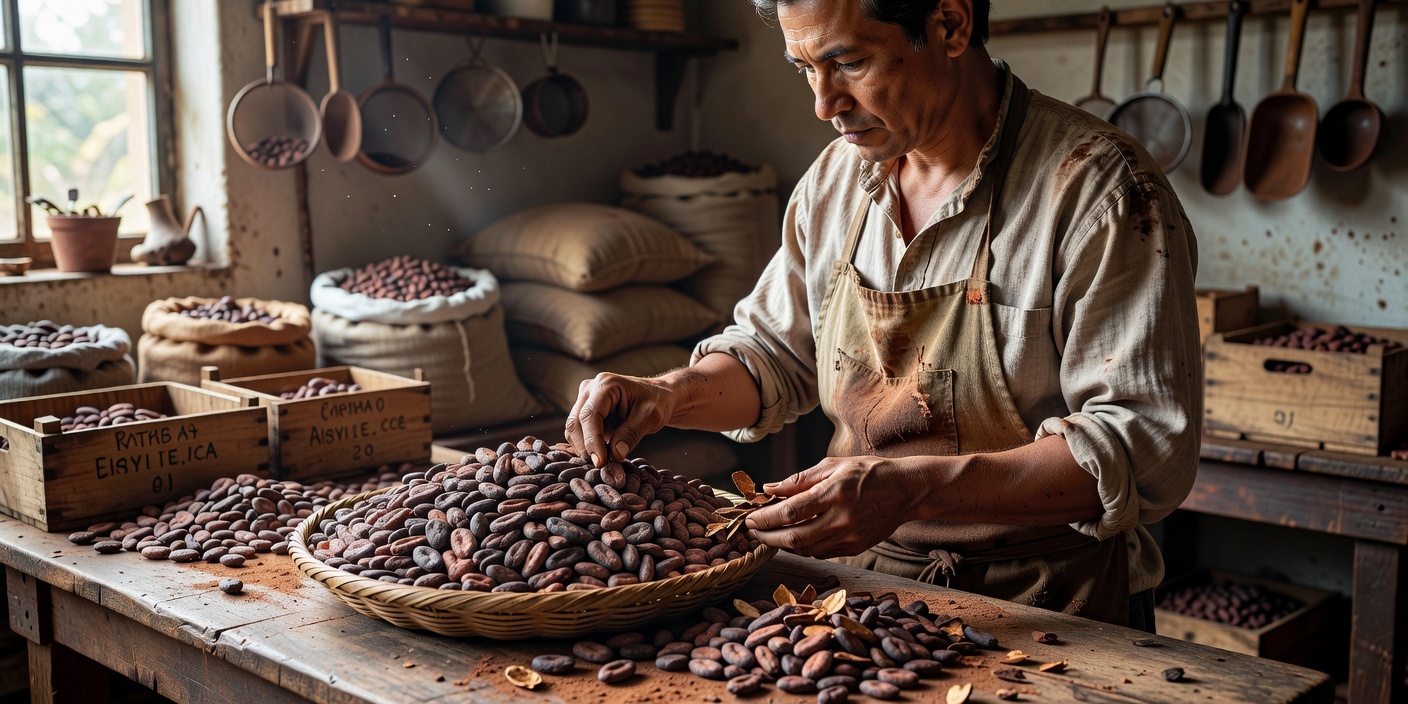
What Does "Bean-to-Bar" Truly Mean?
Unlike industrial chocolatiers who melt pre-made commercial chocolate liquor or compound blocks manufactured by mega-conglomerates, bean-to-bar craft chocolate makers control every phase of manufacturing starting directly from raw, fermented whole cocoa beans received from specific agricultural estates.
The 6 Pillars of Craft Chocolate Production
- Selective Sourcing & Sorting: Hand-sorting beans to discard flat, cracked, or under-fermented units before roasting.
- Precision Drum Roasting: Tailoring temperature curves (typically 110°C to 135°C) to highlight origin-specific volatile aromatic notes rather than burning the bean into generic dark roast flavors.
- Winnowing: Cracking the roasted bean and using airflow separation to remove the fibrous outer husk, leaving pure cocoa nibs.
- Granite Stone Refining (Melanging): Crushing nibs under heavy granite wheels for 24 to 72 hours, reducing particle sizes below 20 microns (smaller than the human tongue can feel as graininess).
- Conching: Aerating and heating the chocolate mass to expel harsh volatile acetic acids created during fermentation while polishing the cocoa butter mouthfeel.
- Beta-V Crystal Tempering: Carefully heating and cooling the chocolate through 45°C down to 28°C and back to 31.5°C to form stable polymorphic Form V crystals, ensuring an audible snap and lustrous surface.
How to Taste Like a Certified Judge
Always taste chocolate at room temperature (20°C–22°C). Never chew immediately. Place a small piece against the roof of your mouth, allow your natural body heat to melt the pure cocoa butter, and inhale gently through your nose to experience retro-nasal olfaction as the flavour profile evolves.